

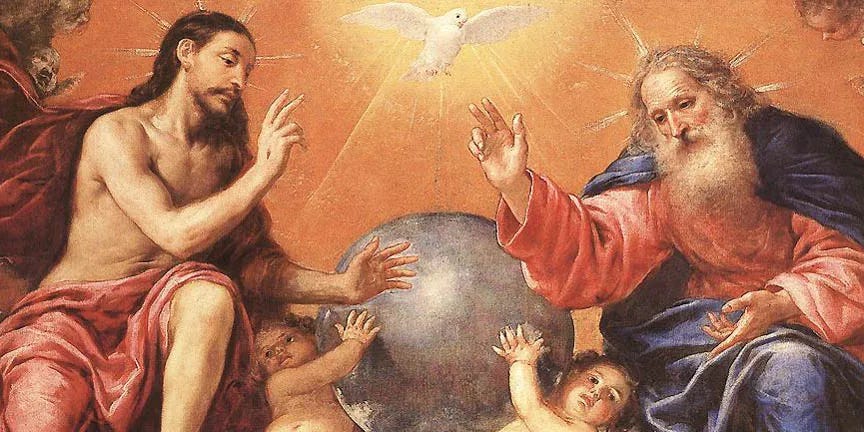
Welcome to the third (a fitting number indeed) installment of the Summa Book Club.
Next month will be all about the Creation. That is a mere 27 articles this time around. Enjoy it, this is one of the shortest sections of the whole three-year schedule.
Q44. The procession of creatures from God (4 articles)
Q45. The mode of emanation of things (8 articles)
Q46. The beginning of the duration of creatures (3 articles)
Q47. The distinction of things in general (3 articles)
Q48. The distinction of things in particular (6 articles)
Q49. The cause of evil (3 articles)
Structure
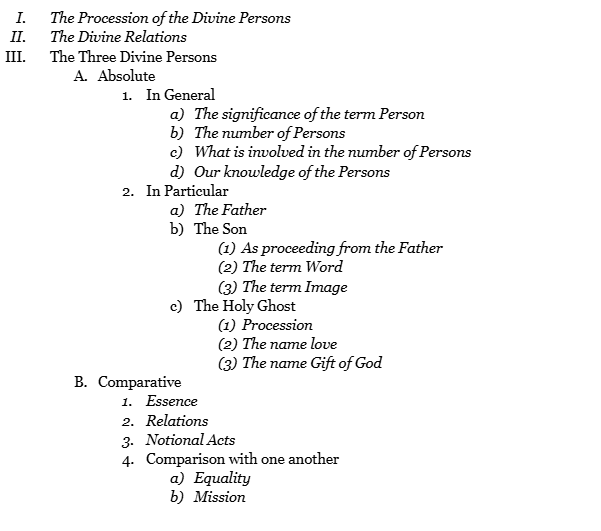
Looking at the outline, it is clear to see that most of the section is the Three Divine Persons of the Trinity considered “absolutely” as meaning “in themselves” rather than the last five questions, which compare them to each other.
Even that section has a breakdown, with four general questions to establish what we even mean and know by “person” and why it would be three of them. The person part we will talk a little about later on in this post.
The Son and the Holy Ghost each get 3 questions devoted to them when the Father only gets 1. The three have the same structure. One about their “procession” and two about titles. As Aquinas shows, the Father doesn’t “proceed,” so it makes sense that He wouldn’t have that one.
The titles (with the other two persons, these sections are more significant and real than they may sound when I use the word “title”) regarding the Father are included in one question rather than two. It is worth noting that “names” of God were covered earlier. These are fitting for the Father, though they apply to all Persons.
Reflections
Imagine a narrow European alley. The walls are close. Steps jut out along with other features. This is how I thought about trinitarian theology. Over the centuries, the Catholic faith has deemed what you can’t say about the Trinity. Big walls on either side. Further distinctions are stairs and stones that block off heresy. And this was impressive to me, how much has been “figured out” via negativa. But this system doesn’t give us things we can say positively. With all that blocked off space, you don’t risk navigating through the alley.

In this section of the Summa, Aquinas drives a sports car through the alley at 60mph.
Confident and calm, not even scraping the sides. The car’s engine in this metaphor is metaphysics. He relies on a well-thought-out idea of “procession”. And this is one of the cool things about the Summa. Yes, it includes a lot of metaphysics and philosophy, but Aquinas uses them as a foundation to do something more: theology.
Crazy how many times you can hear “begotten not made” or “who proceeds from the Father and the Son” and yet not think about it. I mean, you might think about “and the Son” if you like debating with Eastern Orthodox, but the words “begotten” and “proceeding” are not mediated on until you get to stuff like Q33.
After three months and so many questions, one tip for reading the Summa is this: when you are reading the objections first, note in your mind which ones you find the most interesting or convincing. This way, you engage more with the content because you are analyzing it enough to make these rankings, but also, you will now pay more attention to the replies (the ones of your top questions at least).
There is a very real sense that I started to get around question 39 that all the attributes of God, like wisdom and essence, are not being personified in Father and in Son. It is a lot like the experience of knowing something abstractly for a long time and then experiencing it in person.
In these sections, you notice how often Aquinas has recourse to rules of grammar. In other sections, he references aspects of math. This shows how smart he is. It makes me feel bad because those are subjects I’ve learned, but haven’t retained. So I cannot follow the comparison he is making as well as I would like.
Favorite Argument
In article 2 of question 38, Aquinas asks whether “Gift” is an appropriate name for the Holy Ghost and answers like this:
In proof of this we must know that a gift is properly an unreturnable giving, as Aristotle says (Topic. iv, 4)—i.e. a thing which is not given with the intention of a return—and it thus contains the idea of a gratuitous donation. Now, the reason for donation being gratuitous is love; since therefore do we give something to anyone gratuitously forasmuch as we wish him well. So what we first give him is the love whereby we wish him well. Hence it is manifest that love has the nature of a first gift, through which all free gifts are given. So since the Holy Ghost proceeds as love, as stated above (I:27:4; I:37:1), He proceeds as the first gift. Hence Augustine says (De Trin. xv, 24): “By the gift, which is the Holy Ghost, many particular gifts are portioned out to the members of Christ.”
The Holy Ghost is a gift because a gift is related to love. That is nice and simple. It is proved earlier and later in this section that the Holy Ghost is related to Love… the Love between the Father and the Son, in fact, but that is more discussed.
Defining Key Terms
Much of this section hinges on the precision of definitions, and that is the work of Q29.
Person
“the definition of person given by Boethius (De Duab. Nat.) …—that is,”
“a person is an individual substance of a rational nature.”
The full quote says this definition is insufficient… but that quote is an objection. That means Aquinas believes the definition is sufficient. I agree, look at the examples.
Socrates is a person because he is a rational, individual substance. Mankind is not a person because, while rational and a substance, “mankind” is not an individual.
Dogs are not persons because they are neither rational nor individual. Your dog Fido is still not a person because not rational, however, Fido is an individual, so it makes a certain philosophical sense that you think of Fido as “more of a person” than when you think about dogs in general.
St Michael the Archangel is rational, individual, and substantial, so he’s a person. He isn’t material like our other examples, but that is fine.
Because you could never say that God is not a substance, or not rational, or not one, that means that God is a person too by this definition.
That there are three persons is perhaps less clear from that logic, but we can turn to Aquinas in the next question (Q30) to get this:
The definition of “person” includes “substance,” not as meaning the essence, but the “suppositum” which is made clear by the addition of the term “individual.”
This means we are not saying there are three substances-- that would be heretical. The reason that these supposita are separate is that they have a distinction by origin (which is established in Q28). Related and important, but with justification over my head to explain, this means that the word “person” also means relation.
Hypostasis
(Q29 A2) “In the usual way of speaking, it means…
the individual of the rational nature, by reason of the excellence of that nature.”
He also points out that
‘the individuals of the genus substance
…should have a special name of their own, for they are called “hypostases,” or first substances.”
Among the Greeks, the term hypostasis is something more specific than substance, as in a particular individual… which would be closer to Aquinas’ definition of person.
St Jerome said “poison lurks in the word” because to non-Greeks, you could learn hypostasis as substance (which could be correct) but understand the “substance” part of the definition to be related to essence… which we noted above would be heretical. It is better, in Aquinas’ opinion, to translate this to “subsistence.”
Bringing them together
To summarize, a lengthier quote which also gets into the idea of the term “subsistence”:
“Substance means a subject or “suppositum,” which subsists in the genus of substance. To this, taken in a general sense, can be applied a name expressive of an intention; and thus it is called “suppositum.”
It is also called by three names signifying a reality—that is, “a thing of nature,” “subsistence,” and “hypostasis,” according to a threefold consideration of the substance thus named.
For (1), as it exists in itself and not in another, it is called “subsistence”; as we say that those things subsist which exist in themselves, and not in another. (2) As it underlies some common nature, it is called “a thing of nature”; as, for instance, this particular man is a human natural thing. (3) As it underlies the accidents, it is called “hypostasis,” or “substance.”
What these three names signify in common to the whole genus of substances, this name “person” signifies in the genus of rational substances.”
I take this to mean that all persons are hypostasis, but only rational hypostasis are persons. Hopefully, I haven’t been philosophically poisoned and become an accidental heretic. I will correct this post if such an accident comes to my attention.
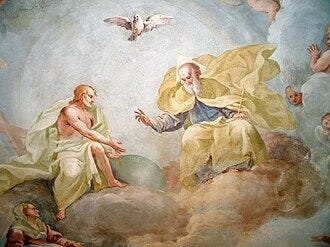
Essential Attributions Appropriated to the Persons
I mentioned above that when reading about attributes ascribed to the Persons of the Trinity, I felt there was a “coming into focus”. The God of the first question, which we knew in the abstract by logically removing any limits from our conception. In these questions, you have those same broad attributes like oneness and being, but each is given a different flavor in different persons. As Aquinas puts it:
Our intellect, which is led to the knowledge of God from creatures, must consider God according to the mode derived from creatures. In considering any creature four points present themselves to us in due order. Firstly, the thing itself taken absolutely is considered as a being. Secondly, it is considered as one. Thirdly, its intrinsic power of operation and causality is considered. The fourth point of consideration embraces its relation to its effects. Hence this fourfold consideration comes to our mind in reference to God.
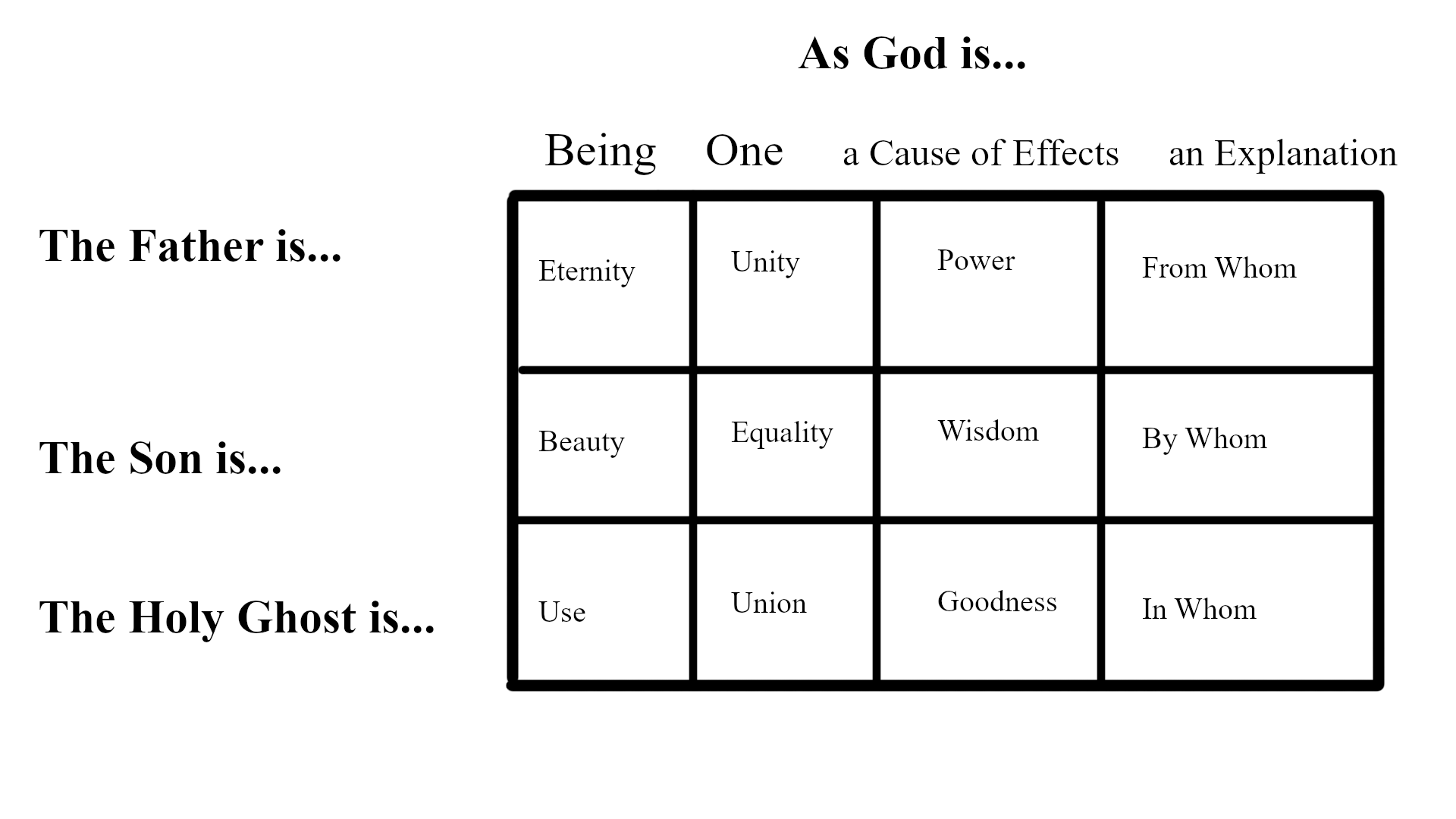
What follows is a very long elucidation of these attributes. I do my best to summarize below, but if you didn’t get there in your reading, this part is well worth it. Note: When I say “is” in each instance, it means “to that person is appropriated” whatever attribute.
In God’s Being
The Father is “eternity”, being without a principle.
The Son is “beauty,” which includes the Son as
perfectly the nature of the Father,
an Image in harmony with the Father, and
The Word is the clarity of the divine Intellect.
The Holy Ghost is “use” in the wide sense of “to use” as “to enjoy.”
The Holy Ghost is Love and Gift (mentioned in another article), and gifts are to be used and enjoyed.
In God’s Oneness
The Father is “unity.”
The Son is “equality.”
The Holy Ghost is “union.”
God in the sphere of Causality
The Father is “power.”
The Son is “wisdom.”
The Holy Ghost is “goodness.”
God in relation to His effects
The Father is “from Whom” as the relationship of the maker.
The Son is “by Whom,” not that the Son is an instrument the Father uses, but in the way an artist works by his art.
The Holy Ghost is “in Whom” in the way things are contained in God as He, in His goodness, preserves and guides them.
Or to make that all much easier in the form of a graph.
Aquinas’ Trinitarian Reading List
Today I am doing another bonus section, one that I think everyone will like in theory, but few will use: a reading list.
In most editions of the Summa, every time Aquinas references another work or appeals to authority (which is often), they will give you the citation. Since I have already broken up the Summa into topical sections, that means if I pull out these citations, I can get Aquinas’ selected readings as if he were designing a class.
I don’t promise that this is a complete list; I probably missed things. I am not including the bible verses. Please let me know if you like this list format, though.
Aristotle (honestly, Aquinas can fit Aristotle… at it seems these same books, into just about everything)
Physics
Metaphysics
Categories
Athanasius
Creed
Sometimes Aquinas just says Athanasius, but from my research, his main Theological works would both apply, being
Orations Against the Arians
On the Incarnation
Augustine
De Trinitas
De Fide ad Petrum
Contra Maxim.
De Verbis Domini, Sermon 38
Super Ps 2:7
Boethius
De Duabus Naturis
De Hebdomadibus
De Trinitas
Commentary on Aristotle’s Categories
Damascene
De Fide Orth.
Dionysius
Div Nom.
Gregory
Moral.
Hilary
De Trinitas
De Synodis
Jerome
Letter of Jerome to Pope Damasus
Master of the Sentences
Sentences
Origen
Homily in Joan.
Someone let me know if this reading list kind of section is helpful and, if so, is there a better way to format it. (Maybe it should be after the conclusion? I don’t want people to think it was my sources, though.)
Conclusion
That was a pretty long one, don’t expect this every week. Join in the fun with your own questions or observations in the comments. (Or corrections if I got something wrong).
This is the link for the GroupMe. Feel free to go on there and discuss beyond the comments, but remember that I won’t be hanging out there much.
And if you feel like you would have been a rich nobleman or noblewoman in the thirteenth century (or some generous merchant), you can support my scholastic philosophy here.