
How Does A Disembodied Intelligence Think?
Aquinas on Angels -- Summa Book Club for July 2026


This week on the Summa readalong we are discussing angels in Questions 50 through 64.
Next Readings
Next month in August, we’re covering Creation again, but this time the six particular days of the creation story in Genesis.
Q65. The work of creation of corporeal creatures (4 articles)
Q66. The order of creation towards distinction (4 articles)
Q67. Work of distinction (4 articles)
Q68. Second day of creation (4 articles)
Q69. Third day of creation (2 articles)
Q70. Work of adornment on the fourth day (3 articles)
Q71. Fifth day of creation (1 article)
Q72. Sixth day of creation (1 article)
Q73. Things belonging to the seventh day of creation (3 articles)
Q74. All seven days of creation in common (3 articles)
29 total articles, a relative breeze, and the first time there have been questions with only one article in them.
Structure
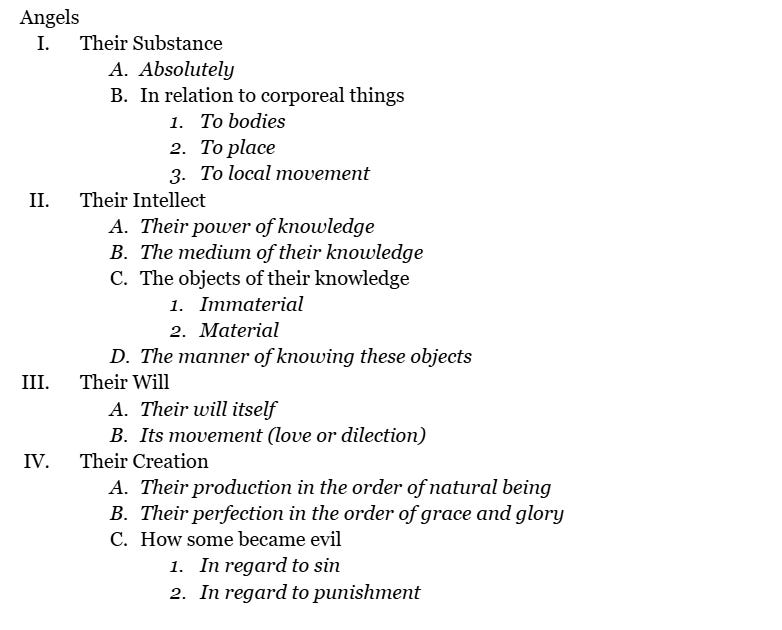
The large sections are substance, intellect, will, and their creation. To most people I imagine the creation section would be the most interesting. Surprisingly (though less so the more I read Aquinas) the intellect section is significantly more involved than the section of the will.
Reactions
It is interesting that in the first couple questions Aquinas is citing Aristotle’s Physics so much. You would think it would be metaphysics since as you will learn it the first section “angels are incorporeal”.
This is supposed to be mind-menting but the start is not so bad in that regard. I was definitely proved wrong about when angels have bodies. I assumed that they aren’t really bodies, but would not have been able to elaborate if you had pressed me on what I mean by “really.” Probably something like the imagination of the observers.
Yet Divine Scripture from time to time introduces angels so apparent as to be seen commonly by all; just as the angels who appeared to Abraham were seen by him and by his whole family, by Lot, and by the citizens of Sodom; in like manner the angel who appeared to Tobias was seen by all present. From all this it is clearly shown that such apparitions were beheld by bodily vision, whereby the object seen exists outside the person beholding it, and can accordingly be seen by all. Now by such a vision only a body can be beheld. Consequently, since the angels are not bodies, nor have they bodies naturally united with them, as is clear from what has been said (Article 1; I:50:1), it follows that they sometimes assume bodies.
It probably helps to make it less mind melting that, on this question at least, I had thought about it. And this leads to a new theory on helping to read and follow the Summa: curiosity. Not in the vicious sense, but if you think about the questions (or even the topics more broadly) before reading them, you will be more engaged with the treatment on that topic.
I got another “woah I can feel myself getting smarter moment” when I read the following.
“Roundness can never be taken from the circle, because it belongs to it of itself; but a bronze circle can lose roundness, if the bronze be deprived of its circular shape.”
I count it as mind expanding because my reaction was “wow that makes a lot of sense, so much so it seems obvious” when I think that a few months ago I would have read over it without reacting much at all.
The next section gets more abstract, probably because my non-metaphysics mind doesn’t think to wonder if angels are XYZ, and particularly because there is a lot of lingo about “knowing” that I am not up to date on with my Aristotle.
A basic thing about the knowledge of angels though seems to be that they get it not from the stuff itself, but from God.
“There are images of creatures in the angel’s mind, not, indeed derived from creatures, but from God…” (Q55, A2, Reply 1)
And angels can derive a lot of truth out of very little.
Thus the higher the angel is, by so much the fewer species will he be able to apprehend the whole mass of intelligible objects. Therefore his forms must be more universal; each one of them, as it were, extending to more things. An example of this can in some measure be observed in ourselves. For some people there are who cannot grasp an intelligible truth, unless it be explained to them in every part and detail; this comes of their weakness of intellect: while there are others of stronger intellect, who can grasp many things from few. (Q55 A3)
What I get from this long quote is that angels need fewer “example” species to “understand” universal forms. As Aquinas points out, it is easier to think about if you put it in terms of how we humans learn from examples of matter. After a see a few shoes, I understand what a shoe is. It especially helps if I see very different types, so I can focus on the broader similarities. Kids usually need more examples before they get it. Angels need fewer… in fact, maybe from the one species of “shoe” they can understand broader concepts like “clothing” or even implied concepts like “feet” without “needing” the example.
My language is definitely imprecise, but I feel like it relates to Intellectual Life because Sertilanges is very encouraging that such connections exist everywhere if you are willing to look for them. The study of biology can teach you about poetry perhaps, because deep Truth is somewhat context independent.
Another place where Aquinas brought things momentarily down to the level to which I could relate: angels don’t know the future.
Although the angel’s intellect is above that time according to which corporeal movements are reckoned, yet there is a time in his mind according to the succession of intelligible concepts… since there is succession in the angel’s intellect, not all things that happen through all time, are present to the angelic mind. (Q57 a3 obj 2)
I hadn’t thought about it too much, but kind of assumed that heaven was entirely outside of time and so the angels would see the future and the past and present all together. Good to know that the demons can’t though.
Even most of the way through the section, and with my brain having not so much melted as zoned out on certain sections where I am weaker on the Aristotle, I keep expecting the other shoe to drop.
Favorite Argument
Now, in natural things, everything which, as such, naturally belongs to another, is principally, and more strongly inclined to that other to which it belongs, than towards itself. Such a natural tendency is evidenced from things which are moved according to nature: because “according as a thing is moved naturally, it has an inborn aptitude to be thus moved,” as stated in Phys. ii, text. 78. For we observe that the part naturally exposes itself in order to safeguard the whole; as, for instance, the hand is without deliberation exposed to the blow for the whole body’s safety. And since reason copies nature, we find the same inclination among the social virtues; for it behooves the virtuous citizen to expose himself to the danger of death for the public weal of the state; and if man were a natural part of the city, then such inclination would be natural to him. (Q60 a5)
What Can Angels Teach Us About Intelligence?
At the risk of this article becoming dated, I want to use Questions 54 through 58 to analyze claims about AI. The comparison should illustrate the intelligence of angels. Frankly, nothing evokes my side of Substack more than a combining scholastic theology of angels with a critique of AI.
This is an intellectually ambitious idea, and can’t be done justice in a mini-essay at the end of my book club post. To give the best shot at it anyway, I will focus on Questions 54 (The Knowledge of Angles), 55 (The medium of that knowledge), and 58 (The mode of that knowledge). Even these are not exhaustive. You could draw out further comparisons in the articles that I am not mentioning.
Power — No sensation (Q54 a5)
In humans, there is a distinction between passive and active intellects.
Passive intellect: the power “which, previous to the act of understanding, is in potentiality to intelligible things, but which becomes actuated in their regard when it apprehends them, and still more when it reflects upon them” (article 4)
Active intellect: the power capable of rendering “natures of the material things which we understand” actually intelligible, considering the difficulty that they “do not exist outside the soul, as immaterial and actually intelligible, but are only intelligible in potentiality”
Material things are potentially understandable. If there is a concept you could just never “get”, that would be a weakness in your passive intellect. When you do understand a concept, it is through the use of your active intellect. The nature of things (the tree-ness of trees) is outside of you at first and now internal.
Angels do not have the distinction, says Aquinas “The distinction of active and passive intellect in us is in relation to the phantasms, which are compared to the passive intellect as colors to the sight; but to the active intellect as colors to the light, as is clear from De Anima iii, text. 18. But this is not so in the angel. Therefore there is no active and passive intellect in the angel.”
AI chatbots, I am going to say… do have a distinction between passive and active “powers” but neither is intellect by these definitions.
The passive elements of AI chatbot are its vocabulary and translation of words to numbers which we will talk about more in the next section, and it’s training on massive amounts of material. In training, a prompt like: “It was a dark and stormy [X]” is paired with a correct answer like: [Night]. Pulling from possible answers, them model randomly tries things and records the results. This ends as a rule.
At first the rule may be “all answers are the word night” but after enough different prompts and answers, that rule will obviously be proven wrong. These final rules seem equivalent to the active elements. They’re called parameters of the language model and are either weights or biases.
These rules are completely arbitrary. Different models have different methods, not real understanding. Random guessing leads to strange approaches that work nonetheless.
Medium - Species (Q55 a2 and a3)
Species is that which is shared both by the actual object and your thoughts about the object.
Species impressa: the impression made by the object upon the faculty. The red ball makes your faculty of sight see redness, but there is not yet any knowledge.
Species expressa: is the reaction of your mind to the impression of faculty of sight as a cognitive process which identifies the redness as united to the ball.
This feels a lot like passive and active intellect, but they are different in at least the important distinction between the thoughts and concepts as objects (I think of the species as a kind of object like one of these) and powers/abilities that humans have regarding them.
Angels do not understand by species drawn from things. They receive the species of things they know from God as a part of their intellectual nature. This means that
Large language models don’t understand at all. As described above, on its own it cannot sense anything. The impressions they have are not made by any objects or ideas themselves, only written descriptions on which they have been trained or prompted.
This may sound a lot like what human beings do when they are reading a book, but St Thomas would likely argue that they are truly engaging an object of the idea within the book. Through describing experiments (of the scientific or thought variety) we can imagine the situation and draw conclusions even if we don’t see what the author writes next. The faculty of logic can detect if something is or isn’t logical. Other non sensitive faculties can and do give us a sense of if things feel true or if we doubt them by inductive or more vibe-based means.
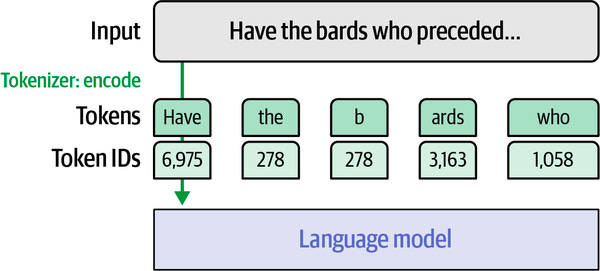
The faculty used by the AI is simply a robotic memory, and the classification is not truth, or color or even vibes, but probability. I think everyone could agree that the object of this faculty and classification is not the ideas themselves. People may not realize that they aren’t even words themselves. Large language models take in text as a arrays of tokens.
These tokens are the vocabulary of an AI and they are not necessarily words or even syllables, much less meanings and concepts. The whole point is to main easier use with a computer by translating them to numbers. (See image below).
Manner — Composing, Dividing, and Discoursing (Q58 a3 and a4)
“the discursive movement of the mind comes from one thing being known through another” (Q58 a3 obj 1)
“But if in the thing perceived something else be seen at the same time, as an object and its image are seen simultaneously in a mirror, it is not discursive knowledge. And in this way the angels know things in the Word.” (ibid)
Angels don’t have to syllogize or “think things through” all of the things that they could know based on an initial fact or observation. “[F]rom the knowledge of a known principle they [can] perceive as known all its consequent conclusions”
Angles do not go from particular instances to commonalities.
Humans do proceed from particular to common. Once we see a few examples we can identify future ones easily. I would say one measure of intelligence is how few examples are needed to produce a convincing member of that set.
AI needs millions of examples. So by that measure, it’s pretty stupid.
Do the large language models syllogize or meaningfully reason? Under the hood, so-called “reasoning chains” look like an added prompt of “how would you think through this question.” Then plug the response back into the original prompt for thinking about the answer.
AI has no internal mechanisms like “don’t contradict” or “avoid appeals to authority” coded in. They cannot because they don’t have enough understanding of concepts to spot a contradiction or an authority.
However, it may point out such things accurately if prompted by the exact terms or general topics where they show up like the LSAT or mathematical proofs. Instead of “sound reasoning”, answers “sound reasonable”. This is exactly what we saw from the marketing of “reasoning models”, that these chains help prevent errors.
This paper shows what I am talking about in that it conveniently only has results drawn from prompts that begin with “you are an expert in syllogistic reasoning”. I find it unlikely that chain of reasoning responses when shown, would naturally resort to syllogisms unless a secret prompt was added in the fine tuning.
Composing and Dividing
Aquinas mentions that human intelligence often works through composition or division.
“in the intellect composing and dividing, the predicate is compared with the subject. For if our intellect were to see at once the truth of the conclusion in the principle, it would never understand by discursion and reasoning.” (Q58 a4)
X is not Y. Or X is Y. Dogs are not cats. This creature I see is a dog. More generally, I understand this as breaking down a concept into smaller parts to understand it, or especially when being creative, combining two concepts that are seemingly separate to get something original or insightful.
AI tokenization translates words, syllables, or other sentence pieces into numbers and compares them with all the other numbers they should go with. What we haven’t talked about yet is attention.
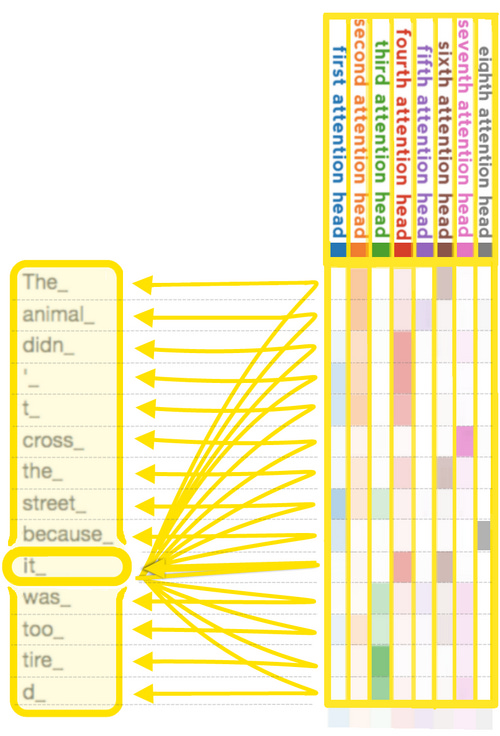
When the probability model analyzes connections, it doesn’t just look at the next token to write the next word. As seen in this picture, it also jumps across the words to see which are most relevant to each other. The picture above is referencing the word “it.” In orange “The” and “animal” are guessed to be relevant. In green “tired” and “was” are deemed most related. We know as humans why those are related, the language model does not and doesn’t need to to produce the text.
This is a kind of composing. Attention mechanisms are also used to reduce the compute time, with the response related much more to the beginning and ending of the prompt as opposed to the middle section. That could be seen as a kind of dividing, cutting those off and treating them separately (or in a separate manner at least).
But I would call it “blind composing” because the attentional, probabilistic relationship with a subject and an object is, to the language model, the same type of relationship whether positive or negative. Just like in the example above the subject-pronoun connection is one connection and separately the object-attribute is just another type of connection. It knows they are related somehow and can produce tokens accordingly.
As for division, I feel it may be appropriate to call a large language model a “locked divider” . The token vocabulary is set from the beginning and the reasoning chains discussed above kind of look like a breaking down into multiple steps, they also cannot be decided on by the model’s internal rules and math. They happen externally or are hard coded.
Mini Essay Conclusion
Working on this not-so-mini essay, I have worried that I have strayed too far from Aquinas and into computer science, but I remembered that part of the point of this whole 3-year project is to help myself and readers to be “generally smarter.” Walking through these articles about angel intellect and comparing them to humans and to AI does a couple things.
Debunk the idea of AI hype men and modern philosophers that intelligence is vague and amorphous.
Intelligence has knowable aspects like potency, species, discursion, composition, and division.
Further, each of these have enough concreteness and legitamate definition to talk about their nuances.
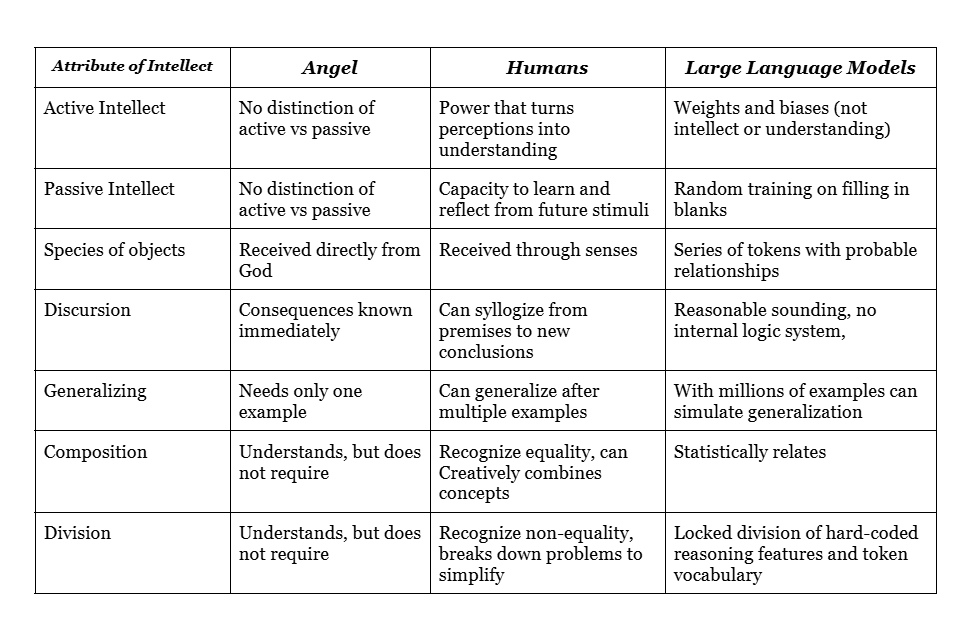
It’s a bit playful and admitedly one sided to compare angels with AI, even though both are called disembodied intelligence. But looking at two extremes in each category can show us more about our human intelligence which falls somewhere in the middle. The practice itself is an example of composition and division.
Basically, you can summarize this whole tangent with the following table, which I think is pretty cool, and almost certainly a novel way of looking at this section of the Summa and the philosophy of computer science. Feel free to site me in future graduate thesis papers.
Reflection Conclusion
I hope that some of you are Aquinas or Theology nerds and will leave insightful comments. I hope to one day include such remarks at the tail end of posts. For now, I’ll have to be content with Substack notes that were not necessarily directed at me.
This is the link for the GroupMe. Feel free to go on there and discuss beyond the comments, but remember that I have a flip phone and I won’t be hanging out there much.
And if you feel like this was good intellectual work that deserves reward, or poor work that needs improvement, you can make an investment in the betterment of my passive intellect while writing (aka caffeine) by buying me a coffee here.